Body
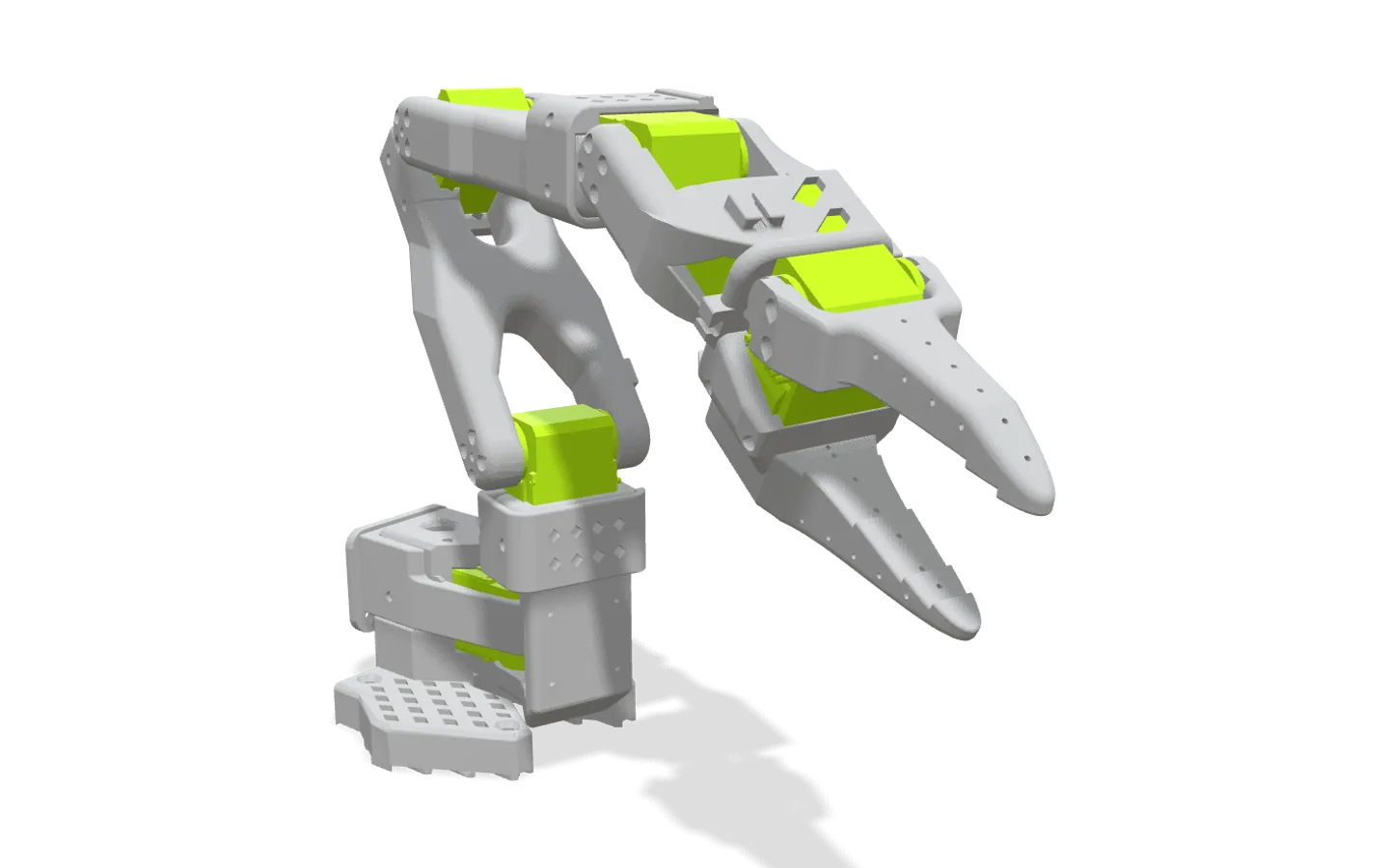
- This small robot arm has six motors (highlighted), one at each joint, where the arm bends or turns.
- Pull it apart. Plastic parts and motors take turns, from the base to the gripper. Tap any part to see what it does.
- Each motor holds up every part further out, toward the gripper. With the arm stretched out, which motor works hardest to stop it sagging?
- So the motors near the base must be strongest, and the gripper can carry only light things. Linked parts like this form a kinematic chain.
Parts
- Base
- Base motor
- Shoulder bracket
- Shoulder lift motor
- Upper arm
- Elbow motor
- Forearm
- Wrist bend motor
- Wrist
- Wrist turn motor
- Fixed finger
- Gripper motor
- Moving finger
A robot arm is a chain: each motor moves everything after it, so the motors nearest the base work hardest.
- A humanoid is shaped like us so it can use our doors, stairs and tools.
- It has 23 motors, one in each joint, where the body bends or turns. Guess where most of them are.
- The legs carry the whole body, about 35 kilograms, and keep it from falling, so they get the strongest motors.
- The chest cover swings open: the battery and computer sit inside. One charge lasts only about two hours, which limits its working time.
- Each motor adds one way to move, called a degree of freedom. Hands with fingers need about as many motors as the legs.
Parts
- Legs
- Arms
- Waist
- Hands
- Torso and head
Over half of a humanoid's motors move its legs and keep it balanced, hands with fingers need about as many again, and the battery limits how long it can work.
- Most robots hold things with a simple clamp: two fingers and one motor. It can only open and close.
- Your hand packs about 20 ways to move into a small space: each finger bends at three joints and swings sideways at the knuckle.
- A robot hand that copies yours can have a motor at every joint. This one has 16, where the clamp has one.
- Your fingertips are packed with touch sensors that feel a slip begin. Robot fingers need sensors too; a plain clamp feels nothing.
- A test: turn a held key a quarter turn, using only the fingers. Moving things within the hand is called dexterous manipulation.
A human hand packs about 20 ways to move and dense touch into a small space; most robots use a simple two-finger clamp instead and lose most of that.
Move
- An arm only controls its joints. Turn the shoulder and the hand swings in an arc.
- To pick up a cup, the robot must find an angle for every joint at once. Drag the cup and watch it work them out.
- Now the cup slides much further away.
- Some places can be reached two ways: elbow up or elbow down. The faint arm shows the other way.
- Turning joints to see where the hand goes is forward kinematics. Working backwards from the hand to the joints is inverse kinematics.
The robot works backwards from where the hand must go to an angle for every joint, and some places it simply cannot reach.
- Every body has a balance point, where its weight is centred. The dot marks it on a robot dog and a humanoid.
- The shaded patch spans the feet on the ground. While the spot straight below the dot stays inside it, the robot stays up.
- Both robots get the same push, and both balance points move the same distance forward.
- When walking, only some feet touch the ground. The patch shrinks, the spot often falls outside it, and each new step catches the fall.
- This patch is called the support polygon. Balance changes fast: one robot dog adjusts its legs 200 times a second to stay up.
A robot stays up while its balance point is over the patch between its feet; four feet make a big patch, two make a tiny one.
- Four motors, a battery and a flight computer. Seen from above, two propellers spin clockwise and two counter-clockwise.
- Spin all four at the same speed and it hovers: their upward push matches its weight. Faster together, it climbs.
- Now fly forward. No propeller points forward, so something else has to push it that way.
- Each propeller twists the drone against its spin. Speed up the clockwise pair and their twist wins: the drone turns counter-clockwise.
- A gust tips it. The flight computer feels the tilt and resets the four speeds, often 400 times a second. This is attitude control.
Parts
- Frame
- Motors
- Propellers
- Battery
- Flight computer
Only by changing its four propeller speeds: speed up the back pair to tilt and fly forward, and speed up one spinning pair to turn.
- A robot's gripper must reach the can on the far shelf. Going straight there, it hits the shelf in between.
- Pick a random point. Step a short way toward it from the closest spot already reached. Keep the step only if it hits nothing.
- Repeat thousands of times. The kept steps branch out into a tree that creeps into every open gap.
- When a branch reaches the goal, follow it back to the start. Then cut every corner where a straight shortcut is safe.
- Drag the shelf: the tree regrows. A fast version of this rapidly-exploring random tree plans a typical arm path in 40 millionths of a second.
It tries random moves, keeps the safe ones, and grows a tree until a branch reaches the goal.